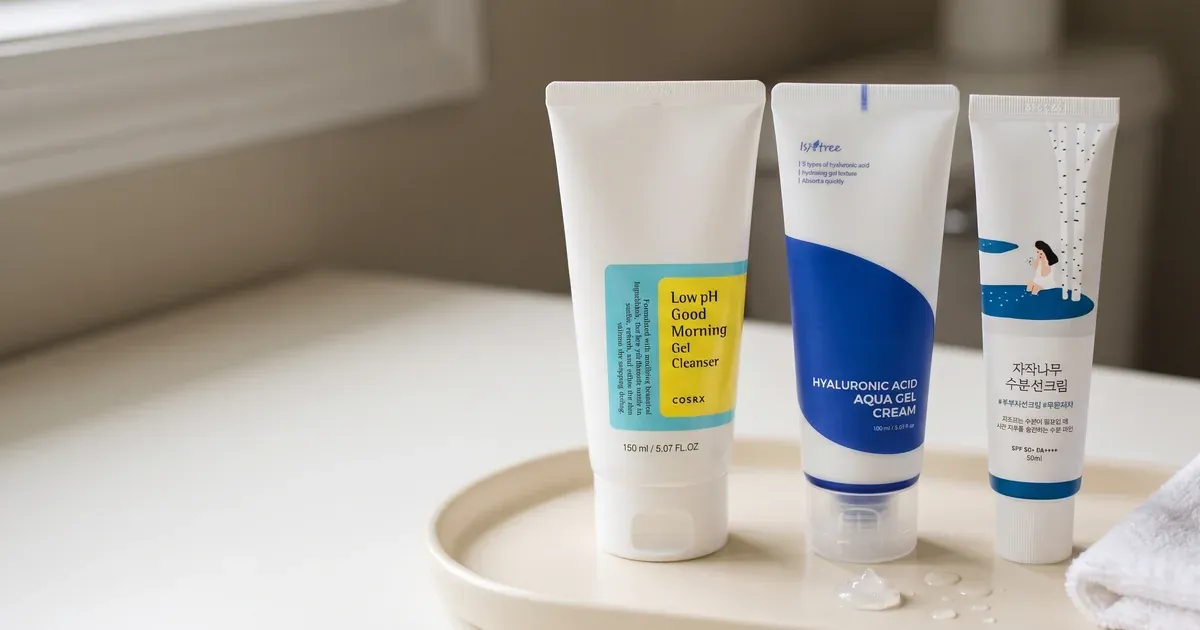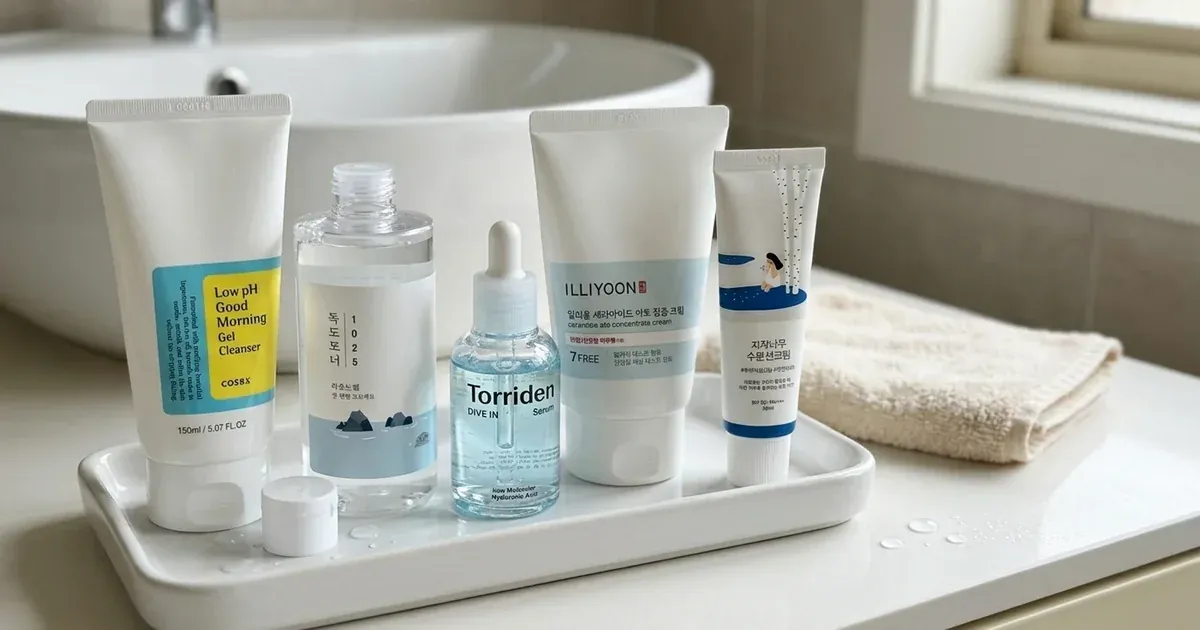
Plenty of people build one skincare routine and run it twice a day. That works up to a point, but your morning and evening routines have different jobs. In the morning, you are getting your skin ready for daylight. At night, you are taking off everything it carried through the day, and that is when slower treatments fit.
Below: what stays the same in both routines, what belongs only in the morning, what belongs only at night, and why splitting your actives between the two makes life easier for your skin.
This guide is put together from the AAD, Cleveland Clinic, the FDA and Harvard Health, with each point linked to its source. We haven’t run this routine on our own skin for this piece (how we review).
What stays the same, morning and night
Start with the parts that don’t change. The AAD recommends washing your face once in the morning and once at night, as well as after sweating heavily. The method is the same both times: a gentle, non-abrasive cleanser without alcohol, lukewarm water, your fingertips rather than a washcloth or sponge, and a soft towel to pat dry.
The overall shape stays the same too. The AAD describes a simple, three-step approach: cleansing, moisturizing and protecting your skin. If you are still building that base, our beginner’s routine walks through it.
And the order rule holds morning and night. Cleveland Clinic says your routine should go from lightest to heaviest, or thinnest to thickest, so watery layers come before creams whichever time of day it is.
Morning: get ready for daylight
The morning routine is built around sunscreen, and the step that pairs best with it is vitamin C. The AAD shares a dermatologist’s advice to apply vitamin C after washing your face in the morning, before you put on sunscreen. Cleveland Clinic dermatologist Melissa Piliang says it is safe to use overnight, but recommends the morning because of the way it serves as a backup to sunscreen.
Sunscreen itself comes last. The AAD says to always put sunscreen on after your other skin care products and beneath your makeup. Choose one with broad-spectrum (UVA and UVB) protection, an SPF of 30 or higher, and water resistance, as the AAD advises. For your face, the AAD suggests at least 1 teaspoon, about enough to cover the length of your index and middle fingers. Put it on before you go outdoors: it takes approximately 15 minutes for your skin to absorb it and protect you.
What about the SPF in your moisturizer or foundation? Cleveland Clinic says it is still best to apply a separate facial sunscreen. The AAD adds that to get SPF benefits from makeup, you would need a makeup with SPF 30 or higher, and you would have to reapply it every two hours.
The morning routine also doesn’t end when you leave the house. If you are outdoors, the AAD says to reapply sunscreen every two hours, and immediately after swimming or sweating. The FDA gives the same advice: at least every two hours, more often if you are swimming or sweating. If you are still choosing a formula, see our guide to Korean sunscreens.
Evening: take the day off, then treat
The evening routine starts by undoing the morning. The AAD says to always remove your makeup before going to bed, because leaving it on while you sleep can age your skin more quickly and cause breakouts.
This is where double cleansing comes in, if it fits your day. Cleveland Clinic describes it as cleansing your face twice, first with an oil-based product and then with a water-based cleanser. It can be helpful if you wear makeup, especially waterproof makeup or waterproof sunscreen. It is also usually not necessary: on a makeup-free day, a single cleanse may be all your routine needs. Our double cleansing guide covers how to do it without overdoing it.
Once your skin is clean, the evening is the natural slot for treatments. The AAD says that if you are using medicine or another treatment on your skin, you should apply it right after cleansing. For retinoids, the AAD shares a dermatologist’s advice to apply them before bed: after washing your face, wait 20 to 30 minutes and then apply. After that, finish with your moisturizer, thinnest to thickest as always.
Why splitting actives between morning and night helps
Follow the two rules above, vitamin C in the morning and a retinoid at bedtime, and you have already kept them apart. That separation is useful. Harvard Health advises caution when combining acid-containing serums with other products that also contain acids, and gives the example of a vitamin C serum, which is acidic, used together with a retinol cream: your skin may get irritated.
Vitamin C has another pairing to be careful with. Cleveland Clinic notes that mixing a vitamin C serum with chemical exfoliants such as alpha-hydroxy acids can throw off the pH balance of your skin.
Splitting your routine also keeps each session short. The AAD warns that using too many products may irritate the skin, especially if you are using more than one anti-aging product. A dermatologist quoted by Cleveland Clinic recommends only using one serum at a time. Two routines give you two slots, so you rarely need to stack. For more on where each active goes, see our guide to layering actives, and if your skin is already stinging, start with our barrier reset routine.
FAQ
Do I need a different skincare routine in the morning and at night? The basics stay the same: the AAD recommends washing your face once in the morning and once at night, and a simple approach of cleansing, moisturizing and protecting. What changes is the job. Mornings end with sunscreen; evenings start by taking makeup and sunscreen off.
Should vitamin C go in my morning or evening routine? The AAD says to apply vitamin C after washing your face in the morning, before sunscreen. Cleveland Clinic dermatologist Melissa Piliang says it is safe overnight but recommends the morning, because it works as a backup to sunscreen.
When should I use a retinoid? The AAD shares a dermatologist’s advice to apply a retinoid before bed, waiting 20 to 30 minutes after washing your face.
Do I need to double cleanse every night? Cleveland Clinic says double cleansing is usually not necessary. It can help if you wear makeup, especially waterproof makeup or waterproof sunscreen.
Is the SPF in my moisturizer or foundation enough? Cleveland Clinic says it is still best to apply a separate facial sunscreen. The AAD notes that to get SPF benefits from makeup, it would need SPF 30 or higher and you would have to reapply it every two hours.
The bottom line
Your morning and evening routines share the same foundation: a gentle cleanse, a moisturizer, and layers that go from thinnest to thickest. The difference is in the bookends. Mornings finish with sunscreen, with vitamin C tucked in before it. Evenings begin by taking the day off, then make room for treatments like a retinoid. Keep the two apart, keep each routine short, and if your skin starts stinging, do less, not more.