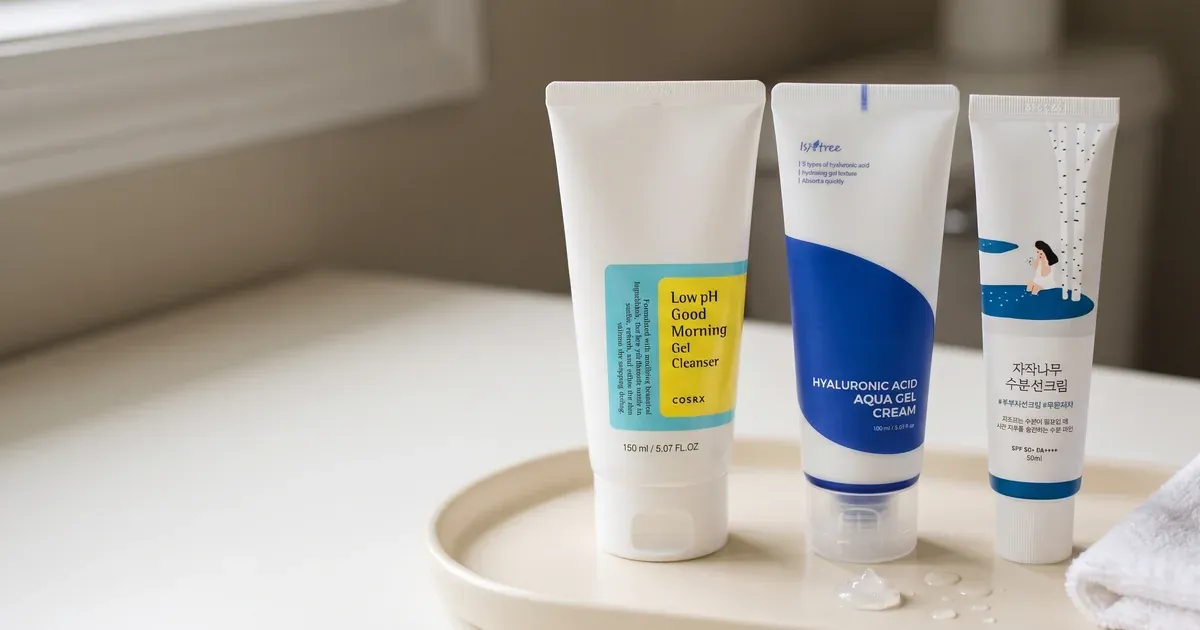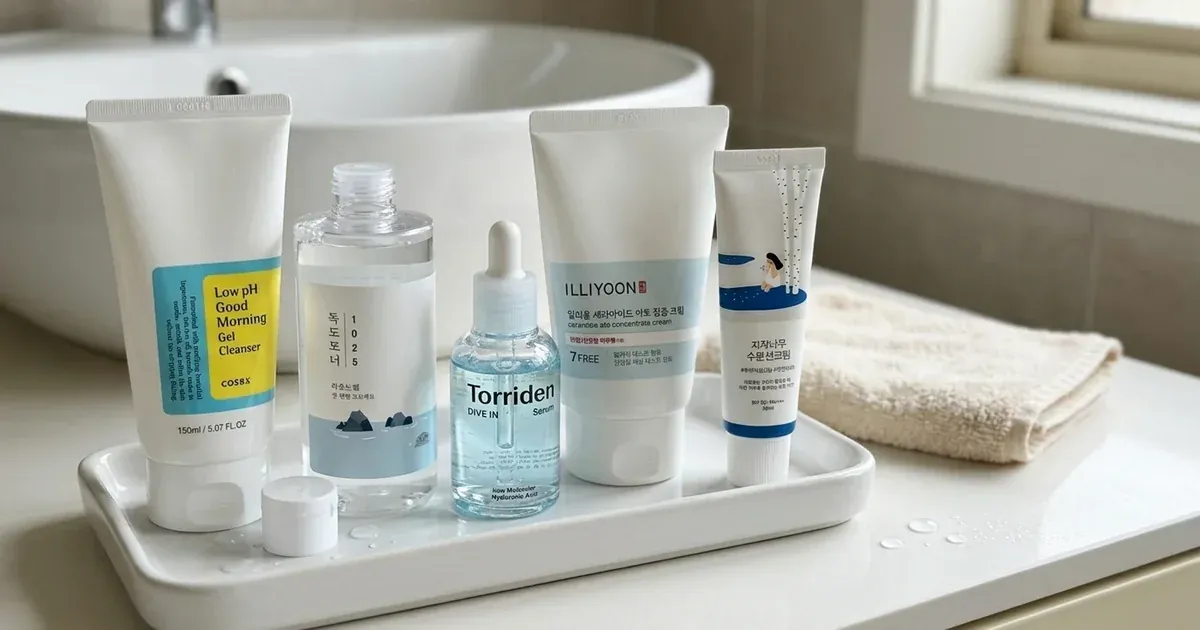
Some products pictured on this page are shown for illustration only and aren’t covered in this article.
Scroll through skincare photos for long enough and glass skin starts to look like it needs a shelf full of products and an hour every night. It doesn’t. The routine dermatologists describe is short, and most of the work is in doing a few simple steps gently and consistently.
Below: what glass skin actually means, each step of the routine and how to do it well, and the habits that quietly work against it.
This guide is put together from dermatologist Jane Yoo, the AAD and Cleveland Clinic, with each point linked to its source. We haven’t run this routine on our own skin for this piece (how we review).
What glass skin actually means
Glass skin isn’t a product or a finish you put on top. Dermatologist Jane Yoo describes it as three things happening at once: an intact skin barrier, real hydration, and even tone. She notes that the modern term took off in the 2010s through K-pop, K-dramas and Korean skincare brands.
Of those three, the barrier does the most work. As Dr. Yoo puts it, a compromised barrier scatters light unevenly and tends to look dull or reactive rather than luminous. That is why every step below is chosen to support the barrier first, and why a gentler routine often gets closer to the look than a stronger one.
The five steps that cover it
According to Dr. Yoo, five steps cover it: cleanse gently, hydrate, treat, moisturize, and wear SPF every day.
When you layer them, keep to the order Cleveland Clinic recommends for any routine: from lightest to heaviest, or thinnest to thickest. Here is what each step involves.
Cleanse gently
Cleansing is where many glass skin routines go wrong, usually by doing too much. Dr. Yoo calls over-cleansing one of the most common reasons people can’t get barrier-dependent results like this.
Cleveland Clinic gives three practical rules:
- Use warm water, not hot. Hot water washes away the skin’s healthy natural oils.
- Choose a gentle cleanser. Look for soap-free cleansers that are formulated for sensitive skin and fragrance-free.
- Keep it brief. The ideal way to cleanse is to massage your cleanser on and then rinse it off. Massaging for longer doesn’t add a benefit.
Wondering whether you need a second cleanse at night? Our guide to double cleansing covers when it is worth it and when it isn’t.
Hydrate
Hydration is the second part of the glass skin definition, and timing matters as much as the product. The AAD advises applying moisturizer while your skin is still damp, for example right after a shower or bath, and again whenever your skin feels dry. That advice is written for dry skin, but the habit of applying to damp skin translates well to a hydrating step on your face.
For ingredients, the same AAD page lists options such as glycerin, hyaluronic acid, dimethicone, shea butter and petrolatum.
Treat, one thing at a time
The treat step is where you target tone and texture, and it is also the step most likely to irritate if you pile things on. Two common treatments have a natural time of day:
- Vitamin C in the morning. The AAD shares a dermatologist’s advice to apply it after washing your face in the morning, before you put on sunscreen.
- A retinoid at night. The same AAD article recommends applying a retinoid before bed: after washing your face, wait 20 to 30 minutes and then apply it.
Whatever you choose, keep it simple. Cleveland Clinic shares one dermatologist’s recommendation to use only one serum at a time. For more on splitting treatments across the day, see our morning vs evening routine guide and our guide to layering actives.
Moisturize to protect the barrier
Moisturizer is the step that seals everything in and supports the barrier directly. Cleveland Clinic suggests looking for products that include ceramides, fatty acids and lipids, which naturally make up a large percentage of the skin barrier.
Because it is usually the thickest layer of your routine, moisturizer goes after your hydrating and treatment steps, and before sunscreen in the morning. If your skin already feels tight, stingy or flaky, our skin barrier reset routine is a better starting point than a full glass skin routine.
Wear sunscreen every day
Dr. Yoo lists SPF as an every-day step, not an optional one. Choose a sunscreen with broad-spectrum (UVA and UVB) protection, an SPF of 30 or higher, and water resistance, as the AAD advises.
One application in the morning isn’t the end of it if you spend time outside. The AAD says to reapply every two hours outdoors, and immediately after swimming or sweating. If you are still choosing a formula, our guide to Korean sunscreens compares the popular options.
Realistic expectations, and what gets in the way
It helps to know what you are aiming for. Dr. Yoo points out that the glass skin you see online is often helped along by filters, flattering lighting and editing. Real skin has texture and pores, and that’s normal. Healthy, hydrated skin with even tone is a realistic goal; poreless skin is not.
The other trap is adding more. Dr. Yoo notes that more steps can even backfire if they irritate the barrier. Watch for the signs Cleveland Clinic links to a damaged barrier: dry, scaly or flaky skin, inflammation and irritation, itchiness, rough patches, and stinging, especially when you apply skin care products. If you notice them, cut back to gentle cleansing, moisturizer and sunscreen until your skin settles.
FAQ
What is glass skin? Dermatologist Jane Yoo describes glass skin as three things happening at once: an intact skin barrier, real hydration and even tone. The term took off in the 2010s through K-pop, K-dramas and Korean skincare brands.
What are the steps of a glass skin routine? Dr. Yoo says five steps cover it: cleanse gently, hydrate, treat, moisturize, and wear SPF every day.
Do I need a long routine with lots of steps? No. Dr. Yoo notes that more steps can even backfire if they irritate the barrier. Cleveland Clinic shares one dermatologist’s advice to use only one serum at a time.
What gets in the way of glass skin? Dr. Yoo calls over-cleansing one of the most common reasons people can’t get barrier-dependent results like this. Cleveland Clinic adds that hot water washes away the skin’s healthy natural oils.
Is the glass skin I see online realistic? Dr. Yoo says the glass skin you see online is often helped along by filters, flattering lighting and editing. Real skin has texture and pores, and that’s normal.
The bottom line
Glass skin is less about a specific product and more about a healthy barrier, steady hydration and even tone. Cleanse gently with warm water, hydrate while your skin is still damp, pick one treatment at a time, seal it in with a barrier-friendly moisturizer, and finish every morning with sunscreen. Expect real skin with real texture, and if your skin starts stinging, do less, not more.