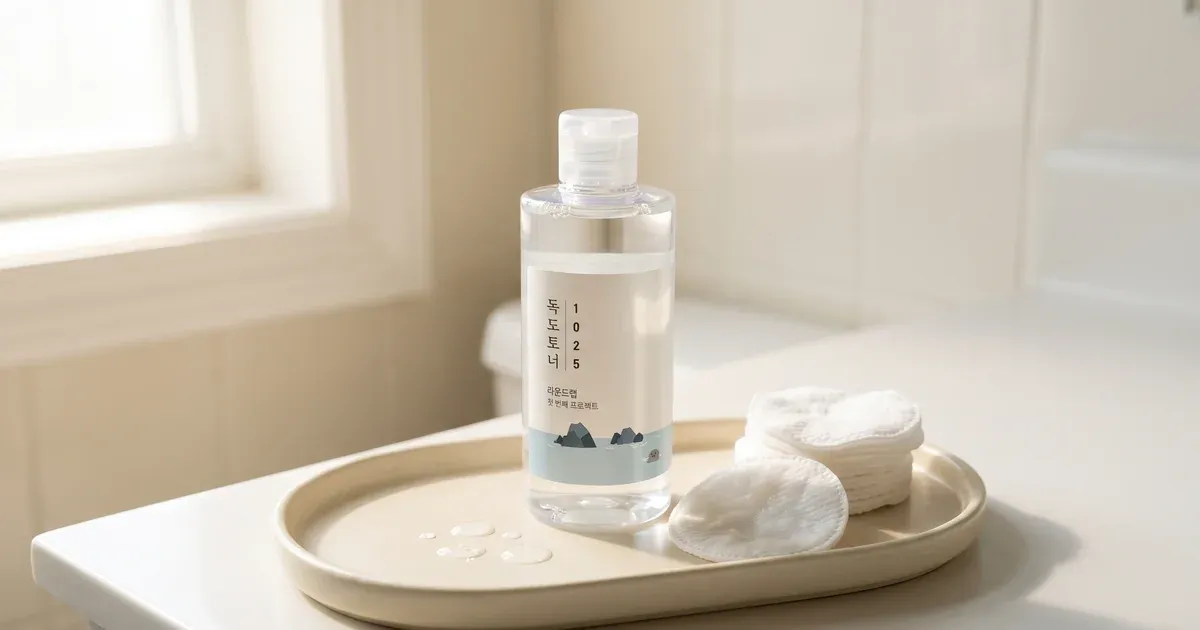
Round Lab’s 1025 Dokdo Toner gets called an exfoliating toner in almost every thread about it. That word makes some people nervous, because they picture an acid toner that stings, and makes others expect a peel in a bottle. Neither picture is quite right, and the reason comes down to one ingredient.
This guide answers that single question: what in the Dokdo Toner exfoliates, how strong it is, and how to use it next to retinol or an acid. If you want the full picture of the toner, texture, sizes and what users say, read our Round Lab Dokdo Toner review.
It is put together from Round Lab’s own product page, the AAD, the US association of dermatologists, and published research on enzyme exfoliants, with each point linked to its source. We haven’t tested the toner on our own skin for this piece (how we review).
The short answer: yes, with an enzyme
Yes, the Dokdo Toner exfoliates, but not with an acid. Round Lab says it removes dead skin cells while filling the skin with moisture, and the exfoliating ingredient on its full ingredient list is protease, an enzyme. There is no AHA, BHA or PHA on the list.
Everything around it is there to hydrate or soothe: glycerin, betaine, panthenol and allantoin, plus sea water, sugarcane extract and a red seaweed extract. Round Lab does not publish how much protease the toner contains, so nobody outside the brand can tell you its strength from the label alone.
What protease does to dead skin
Protease is a type of enzyme that breaks down proteins. Your outer layer of skin is held together partly by proteins, and it sheds old cells on its own over time. A review of enzyme exfoliants by Trevisol and colleagues describes these enzymes as able to mimic that natural shedding process, which is how they work as exfoliants.
That is a different route from an acid. As a chemist’s science blog explains, enzymes are stable over a wide pH range, so they don’t need to be as acidic as AHAs and BHAs to work. A low-pH formula is one of the reasons acid toners can sting; an enzyme toner doesn’t depend on one.
How strong is it next to an acid toner?
Round Lab says four clinical tests back the toner, including 31.79 percent fewer dead skin cells. That figure comes from the brand’s own testing, and its product page gives no sample size or method, so treat it as a claim rather than a result to expect.
Independent evidence on enzyme exfoliants is thin. The Trevisol review found only 11 articles, few of which tested enzymes as exfoliants on people, and concluded that more robust studies on human skin are needed before enzyme exfoliation can be recommended as a treatment.
The closest thing to a head-to-head is a 12-week double-blind study of 75 women with mild to moderate sun damage, who applied their cream twice a day. An enzyme cream made from hydrolyzed salmon roe protein caused fewer instances of stinging and burning than a 4% glycolic acid cream and an 8% glycolic acid cream with 2% citric acid, and the women rated all three products similarly. Keep in mind that this was a different enzyme product, not the Dokdo Toner.
Gentler doesn’t mean risk-free. The Trevisol review notes that enzymes have to be kept stable in a formula, both so they keep working and to avoid allergy or irritation, and the same chemist’s blog points out that enzyme extracts can still irritate sensitive skin. The fair summary: by design, the Dokdo Toner sits on the mild end next to an acid toner, but its strength hasn’t been measured independently.
Can you use it with retinol or an acid toner?
Treat it as an exfoliating step, even a mild one. The AAD warns that prescription retinoids and products with retinol or benzoyl peroxide can make skin more sensitive or peel, and that exfoliating while you use them may worsen dry skin or even cause breakouts. If you use any of those, put the Dokdo Toner on a different night, and don’t stack it with an acid toner or a peel on the same evening.
Round Lab’s directions are simple: after cleansing, soak a cotton pad and gently wipe it along the skin texture. The brand doesn’t say how often. The AAD says frequency depends on your skin type and method, that stronger exfoliation needs to be done less often, and that overdoing it can leave skin red and irritated. Follow with moisturizer straight after, and skip it on sunburned skin or anywhere with an open cut.
Who it suits, and who should go slow
Round Lab lists the toner as good for sensitive skin and all skin types. That is the brand’s own positioning. The AAD suggests that dry, sensitive or acne-prone skin may do better with a mild chemical exfoliator, which is the category a protease toner falls into. It also advises avoiding strong exfoliation if you have a darker skin tone or tend to get dark marks after breakouts, because aggressive exfoliation can increase pigmentation.
Not everyone gets on with it. A few Reddit users say the toner made their skin more sensitive over time, or left it slightly irritated and dry. If your skin reacts easily, patch test first and add it on its own, one new product at a time, so you know what your skin is responding to.
If what you need is calming rather than smoothing, our comparison with a calming toner covers the toner built for that job.
Where to buy it
On Olive Young Global, the 200ml set with a 50ml bottle was US$18.00 (€17.10) for delivery to Germany when we checked on 9 November 2026. Prices change with sales and exchange rates, so check at checkout.
Paid link: The Dew Journal earns a commission on purchases, at no cost to you.
For sizes, texture and what long-term users report, see our full Round Lab Dokdo Toner review.